A, an, the Articles Card Game: A Practical Tool for Language Fluency and Classroom Engagement
Mastering the correct use of articles—a, an, and the—is a foundational skill in English language learning. The A, an, the Articles Card Game offers a dynamic, interactive approach to reinforce this grammar point through play. Designed for educators and learners alike, this game promotes automaticity and fluency while maintaining a fun and competitive environment. Whether used in a classroom setting or for independent practice, it fits naturally into language acquisition workflows, especially when building sentence structure skills.
How the Game Works
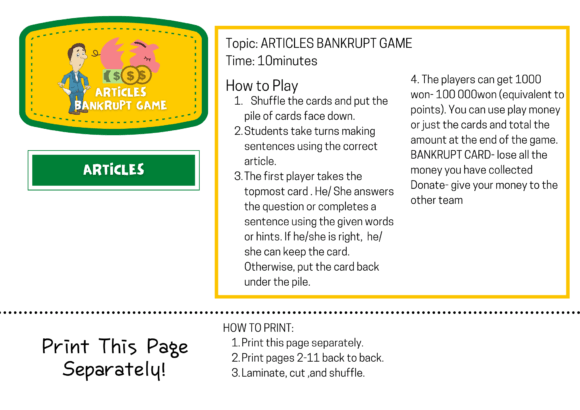
Each card in the A, an, the Articles Card Game features a sentence or phrase with a missing article. Students must choose the correct article—a, an, or the—to complete the sentence. The reverse side of the card includes a monetary value or a special instruction such as "Bankrupt" or "Donate." If the student answers correctly, they collect the amount shown; if not, they move on without earning points.
This format not only reinforces grammar rules but also introduces elements of decision-making and risk management. Students must weigh their confidence in answering correctly against potential gains or losses, making the game an engaging addition to both structured lessons and informal review sessions.
Integration into Learning Workflows
The A, an, the Articles Card Game is flexible enough to be used at multiple stages of a learning cycle:
- Before a lesson to assess prior knowledge and activate schema
- Durring instruction as a formative check for understanding
- After formal instruction to reinforce learning and provide practice
For educators, integrating the game into lesson plans can be done with minimal preparation. It works well as a warm-up activity, a review tool before assessments, or even as a reward-based system during literacy centers or group rotations. Its structure supports spaced repetition, a key component in long-term retention of grammar rules.
Compatibility with Other Teaching Tools and Resources
This game complements a variety of instructional methods and tools commonly used in language learning. It pairs well with grammar workbooks, digital language apps, and sentence-building exercises. Educators can integrate it into blended learning models where students rotate between digital and physical tasks.
Additionally, the game supports collaborative learning. When played in small groups, students can discuss answers, reinforcing peer-to-peer learning and communication. It can also be adapted for use in flipped classrooms, where students preview grammar rules at home and apply them through gameplay during class time.
Practical Implementation Tips
To get the most out of the A, an, the Articles Card Game, consider the following practical implementation strategies:
- Preparation: Print and laminate the 40 included cards using 80-micron pouches for durability and ease of shuffling. This ensures long-term usability and allows for repeated play without wear and tear.
- Materials: Use play money or a simple score sheet to track earnings. Play money adds a tactile element and makes the game more engaging for younger students.
- Rules: Review the game instructions thoroughly before starting. Establish clear expectations around turn-taking, scoring, and handling "Bankrupt" or "Donate" cards to maintain a smooth flow.
- Customization: Modify the difficulty by selecting cards based on the current lesson. For advanced learners, include more complex sentence structures or idiomatic expressions that require article usage.
Workflow Examples for Different Contexts
Here are a few examples of how different users might incorporate the A, an, the Articles Card Game into their teaching or learning processes:
- Classroom Teacher: Use the game during literacy centers twice a week. Rotate students through the game station while others work on independent reading or writing tasks. Track progress by recording scores over time.
- ESL Tutor: Integrate the game into one-on-one sessions as a review activity. Use incorrect answers to identify persistent misconceptions and tailor follow-up instruction accordingly.
- Home Educator: Make the game part of a weekly grammar routine. Combine it with other sentence-building activities and offer small rewards for consistent performance.
- Language Learner: Use the game independently by reading cards aloud and self-checking answers. Keep a notebook to track difficult patterns and revisit them later.
Usability and Organization Considerations
Organizing the game for efficient use is key to ensuring it becomes a regular part of the learning routine. Store the laminated cards in a labeled container or folder for easy access. If using play money, keep it in a separate pouch or envelope to avoid confusion.
For educators managing multiple classes or groups, consider color-coding cards or using different sets for varying proficiency levels. This helps maintain consistency across groups while allowing for differentiation based on student needs.
Quality Control and Long-Term Use
Because the cards are meant for repeated use, quality control starts with the lamination process. Using thin 80-micron pouches ensures that the cards remain flexible and easy to shuffle without curling or sticking together. Regularly inspect the cards for wear and replace any that become damaged over time.
Consider updating or expanding the card set periodically to include new sentence structures or vocabulary that align with current learning objectives. This keeps the game fresh and relevant, especially for returning students or long-term language programs.
Enhancing Engagement Through Game Mechanics
One of the standout features of the A, an, the Articles Card Game is its use of game mechanics to drive engagement. The inclusion of "Bankrupt" and "Donate" cards introduces unpredictability, making the game more exciting and encouraging strategic thinking. Players must decide whether to take risks or play conservatively, which adds a layer of decision-making beyond grammar alone.
This gamified approach aligns well with modern pedagogical trends that emphasize active learning and intrinsic motivation. By turning grammar practice into a game, learners are more likely to stay focused and retain the material over time.
Conclusion: A Versatile Addition to Language Learning
The A, an, the Articles Card Game is more than just a grammar drill—it's a practical, adaptable tool that supports fluency development in a fun and engaging way. Whether used in classrooms, tutoring sessions, or home learning environments, it integrates smoothly into existing workflows and enhances the learning experience through play.
By combining grammar practice with strategic thinking and collaborative learning, this game helps students internalize article usage while enjoying the process. With thoughtful preparation, clear rules, and consistent use, it becomes a valuable asset in any language educator's toolkit.