4 Times Table Multiplication Dice Game: A Fun Way to Boost Math Skills
Engaging Students Without Them Even Knowing
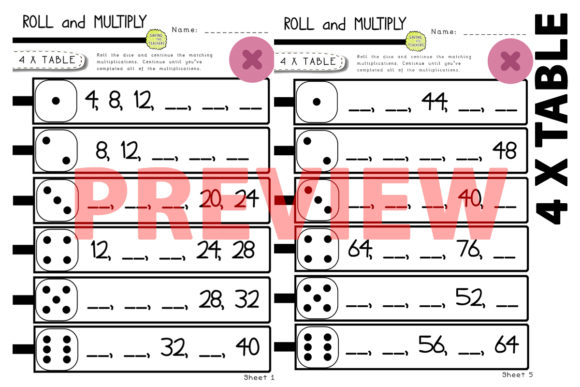
The 4 Times Table Multiplication Dice Game is a clever, interactive method to help students practice their multiplication facts in a way that feels more like play than work. By rolling a dice and completing corresponding multiplication problems on a worksheet, learners stay engaged and motivated. The game is especially effective because it removes the pressure of traditional drills while still reinforcing essential math skills.
This game works well in both classroom and home settings. Teachers can use it as a morning starter activity or a quick filler between lessons, while parents can incorporate it into after-school routines or weekend learning sessions. The element of competition—such as seeing who can complete the sheet fastest—adds a fun twist that many children enjoy.
Real-World Applications and Scenarios
One of the biggest advantages of the 4 Times Table Multiplication Dice Game is its versatility. It can be used in a variety of educational and developmental contexts, including:
- Elementary Classrooms: Teachers can use the game to reinforce multiplication facts during math centers or as a review activity. Since the resource includes 5 differentiated sheets, it’s easy to tailor the difficulty level to each student’s needs.
- After-School Programs: In tutoring centers or enrichment programs, this game can be used as a low-prep, high-engagement tool to support math fluency.
- Home Learning: Parents can use the game to help children maintain math skills during school breaks or to supplement homework. It’s especially useful for children who struggle with rote memorization but respond well to hands-on learning.
- Special Education: For students with learning differences or attention challenges, the tactile nature of rolling a dice and physically marking answers can improve focus and retention.
Who Benefits Most From This Game?
While the 4 Times Table Multiplication Dice Game is designed for children learning multiplication, different users can benefit in unique ways:
- Young Learners (Ages 7–10): These students are typically in the process of mastering their times tables. The game gives them a playful way to build fluency and confidence without the stress of timed tests.
- Struggling Students: Children who find multiplication challenging can benefit from the repetition built into the game, which helps reinforce facts in a low-pressure format.
- Visual and Kinesthetic Learners: The combination of rolling a dice, writing down answers, and visually tracking progress helps students who learn best through movement and interaction.
- Classroom Teachers: Educators appreciate the differentiation options and ease of implementation. With five different sheets, it's easy to match the game to varying ability levels within the same class.
- Parents and Homeschoolers: For those guiding learning at home, the game offers a structured yet flexible activity that can be reused and adapted for different skill levels.
Practical Examples and Classroom Observations
In one third-grade classroom, a teacher introduced the 4 Times Table Multiplication Dice Game as a five-minute warm-up activity. Over the course of a month, she noticed a marked improvement in her students’ speed and accuracy during multiplication assessments. Students who had previously struggled with the 4x table began recalling facts more confidently, often referring to the game during math discussions.
Another teacher used the game as a reward activity for early finishers. She found that students were more motivated to complete their other work quickly and accurately just to have time to play the dice game. Some even asked to take copies home to play with siblings or parents.
In a homeschool setting, a parent used the game with two children at different math levels. The older child used the more advanced sheets, while the younger one worked on the beginner versions. The parent appreciated how the game could be used across grade levels and required minimal setup.
Considerations Before Using the Game
While the 4 Times Table Multiplication Dice Game is a highly effective tool, there are a few considerations to keep in mind before using it:
- Dice Availability: Make sure you have enough dice for each student or group. If dice aren’t available, you can use digital dice rollers or printable dice templates.
- Time Constraints: While the game is great for short bursts of practice, it may not be suitable for very short periods if students are just getting started.
- Differentiation: Take time to assign the appropriate sheet based on each student’s current math level. The five differentiated sheets allow for customization, but matching the right one to each learner is key.
- Repetition: While repetition is beneficial, students may lose interest if the same format is used too frequently. Consider varying the rules or introducing small rewards to keep motivation high.
Strengths and Potential Limitations
Like any educational tool, the 4 Times Table Multiplication Dice Game has its strengths and limitations. Understanding these can help educators and parents use it more effectively.
Strengths:
- Engaging and Interactive: Turns math practice into a game, increasing student motivation.
- Low Prep: Requires minimal materials—just a dice and printed sheets.
- Flexible: Can be used in a variety of settings and adapted for different skill levels.
- Reinforces Recall: Helps build automaticity with multiplication facts through repeated practice.
Potential Limitations:
- Limited Scope: Focuses only on the 4x table, so it should be used alongside other multiplication resources.
- Requires Supervision: Younger students may need guidance to understand the rules or stay on task.
- May Become Predictable: Repeating the same format too often could reduce its effectiveness over time.
Final Thoughts
The 4 Times Table Multiplication Dice Game is a simple yet powerful way to reinforce multiplication facts without overwhelming students. Whether used in the classroom, at home, or in after-school programs, it offers a fun and effective alternative to traditional drills. By incorporating elements of play and competition, it keeps students engaged while helping them build critical math skills that will serve them throughout their education and beyond.